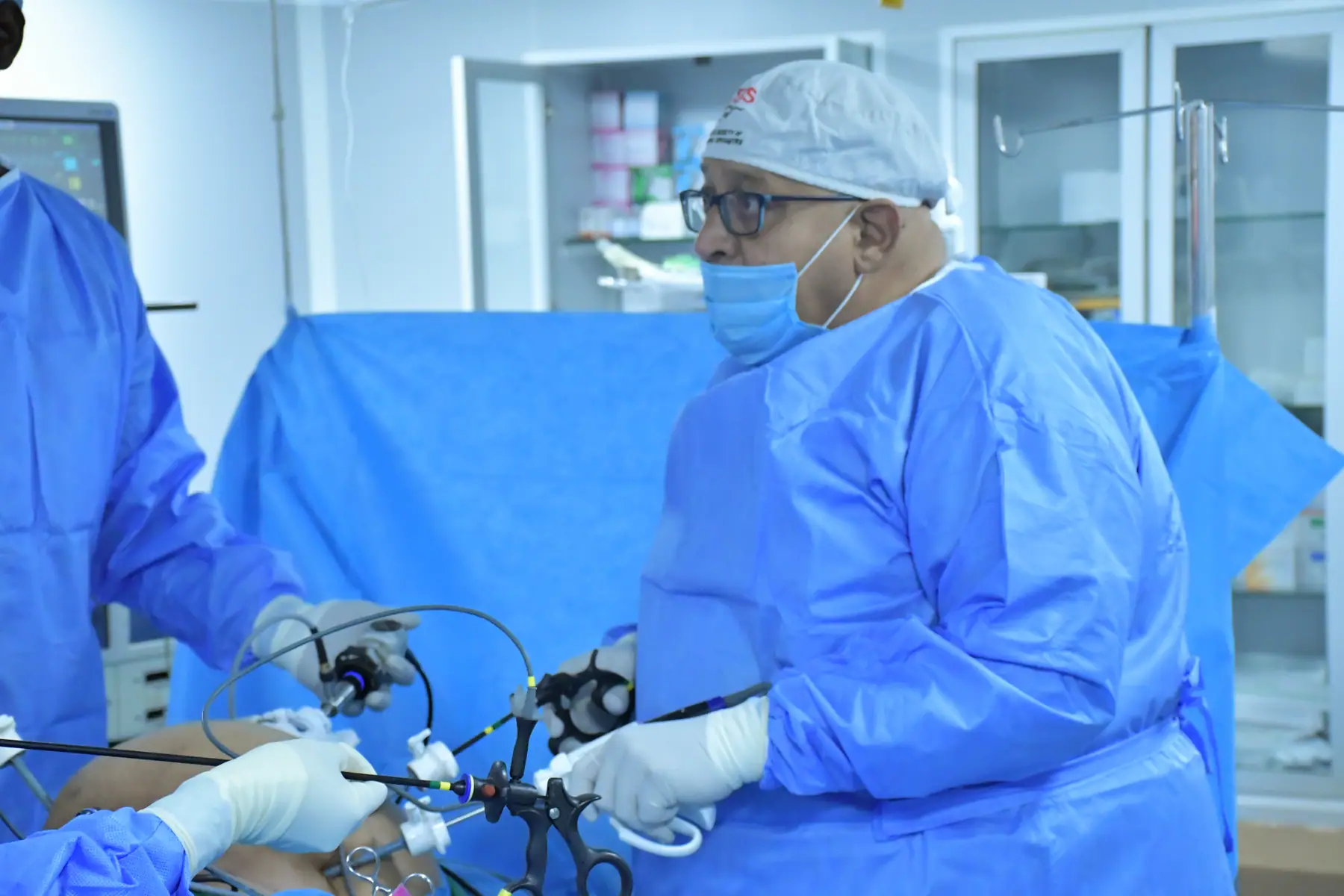

Patients increasingly arrive at consultation having read about robotic surgery and wondering whether conventional laparoscopy is somehow second best. It isn't. Both are minimally invasive, both use the same small incisions, and for the majority of gynecologic operations the published outcomes are broadly equivalent. What differs is cost, availability, and a handful of situations where one genuinely has the edge.
What is actually different
In conventional laparoscopy the surgeon stands at the table and operates the instruments directly. In robotic surgery the surgeon sits at a console a few metres away and controls instrument arms that translate hand movements into scaled, tremor-filtered motion, with wristed instruments and 3D vision.
The patient-side experience is nearly identical: general anaesthetic, keyhole incisions, gas insufflation, same-day or next-day discharge for most procedures.
Ask how many of your operation the surgeon does each year before you ask what machine they use. Volume beats hardware.
What the outcome data shows
Across hysterectomy, myomectomy and endometriosis surgery, large comparative studies show similar complication rates, similar blood loss and similar length of stay between expert laparoscopy and robotics. Robotic cases often take somewhat longer in theatre and cost substantially more.
Robotics shows its clearest advantage in deeply confined spaces and complex suturing — extensive deep infiltrating endometriosis, some complex myomectomies, and certain oncologic procedures in patients with a high BMI.
Why surgeon volume matters more than the platform
The single strongest predictor of a good outcome in minimally invasive gynecology is not the equipment — it is how many of your specific operation the surgeon performs each year. A high-volume laparoscopic surgeon consistently outperforms an occasional robotic user, and the reverse is equally true.
This is why we counsel patients to ask about case numbers, conversion rates to open surgery and complication rates before asking about the machine.
The cost question in the East African context
Robotic consumables and platform costs are considerably higher, and in most regional settings this is passed to the patient or is not covered by insurance. For an operation where outcomes are equivalent, that difference buys nothing clinically. Where a robotic approach genuinely improves safety for a complex case, it is worth discussing referral.
Questions to ask before choosing an approach
- How many of this exact procedure do you perform each year?
- What is your conversion rate to open surgery?
- Would a robotic approach change my expected recovery or risk?
- What is the total cost difference, and what does my insurer cover?
Common questions
Is robotic surgery safer than laparoscopy?
For most gynecologic procedures, no — outcomes are comparable in expert hands. Robotics has advantages in specific complex cases involving deep pelvic dissection and extensive suturing.
Will my scars be different?
No meaningful difference. Both use several small incisions, typically 5–12mm, that heal to fine lines.
Book a consultation with Prof. Parkar
A private, unhurried appointment to review your history and design a plan that fits your life.